
Meta Ships Muse Glimmer: a 30B Agent Model for Your Own PC
Meta's new open-weights model Muse Glimmer runs 4-bit quantized on a single consumer GPU — Apache 2.0 licensed, with vision input and 131k context.
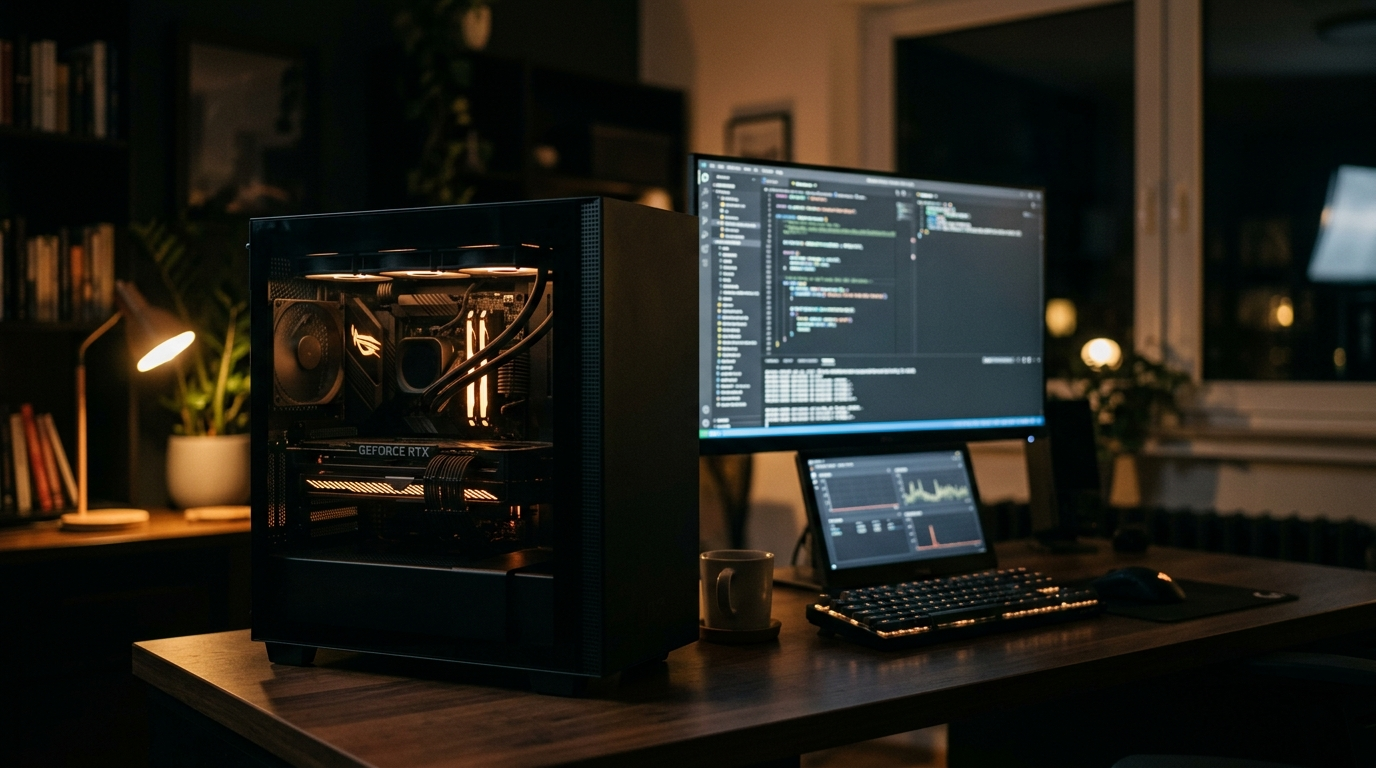
Illustration · AI-generated (AI IN LIFE)
At a glance
- 30B parameters incl. ~1.8B vision encoder; text and image input, 131k+ token context
- Runs in 24 GB VRAM at 4-bit quantization (~1% quality loss)
- DFlash speculative decoding: 3.1x speedup on RTX 5090 (233 tok/s)
- Apache 2.0 license; BF16, GGUF and ExecuTorch weights on Hugging Face
- Beats Gemma4-31B and Qwen3.6-27B on MCP Atlas, DeepSearch QA and SWE-Bench Pro
Meta has released Muse Glimmer, a 30-billion-parameter model built specifically for local agent workflows. The dense transformer understands text and images, offers a context window of over 131,000 tokens, and ships under an Apache 2.0 license — with BF16, GGUF and ExecuTorch weights on Hugging Face.
The hardware story is the real pitch: at full precision the model needs over 55 GB of memory, but after 4-bit quantization it fits in 24 GB of VRAM — with roughly one percent quality degradation, according to Meta. That means a single RTX 5090, or Apple Silicon Macs in the M4/M5 Max class.
Speed comes from DFlash speculative decoding: on an RTX 5090, throughput jumps from about 75 to 233 tokens per second — roughly a 3.1x speedup. On an M5 Max, speed doubles to around 50 tokens per second.
On agent benchmarks such as MCP Atlas, DeepSearch QA and SWE-Bench Pro, Meta says Muse Glimmer beats comparable open models like Gemma4-31B and Qwen3.6-27B, though it trails on terminal tasks. Self-hosted, there are no per-token costs.
Local agents are the next battleground for open weights. For companies with strict data requirements — especially in Europe — a capable agent model that runs entirely on-premise is a meaningful building block: sensitive data never leaves the building.
FAQ
What hardware do I need?
Quantized, a 24 GB VRAM GPU (e.g. RTX 5090) or an M4/M5 Max Mac is enough; full precision needs over 55 GB of memory.
Can I use it commercially?
Yes — the weights are Apache 2.0 licensed, including commercial use and derivatives, with no token fees when self-hosting.
What is it built for?
Local agent workflows: tool use, research, software tasks — with vision input and long context, entirely without the cloud.