
Claude Pushes a 160-Year-Old Math Bound From 41.6% to 67.2%
An unreleased Claude version raised the lower bound for zeta zeros on the critical line from 41.6 to 67.2 percent — with a Lean-verified proof.
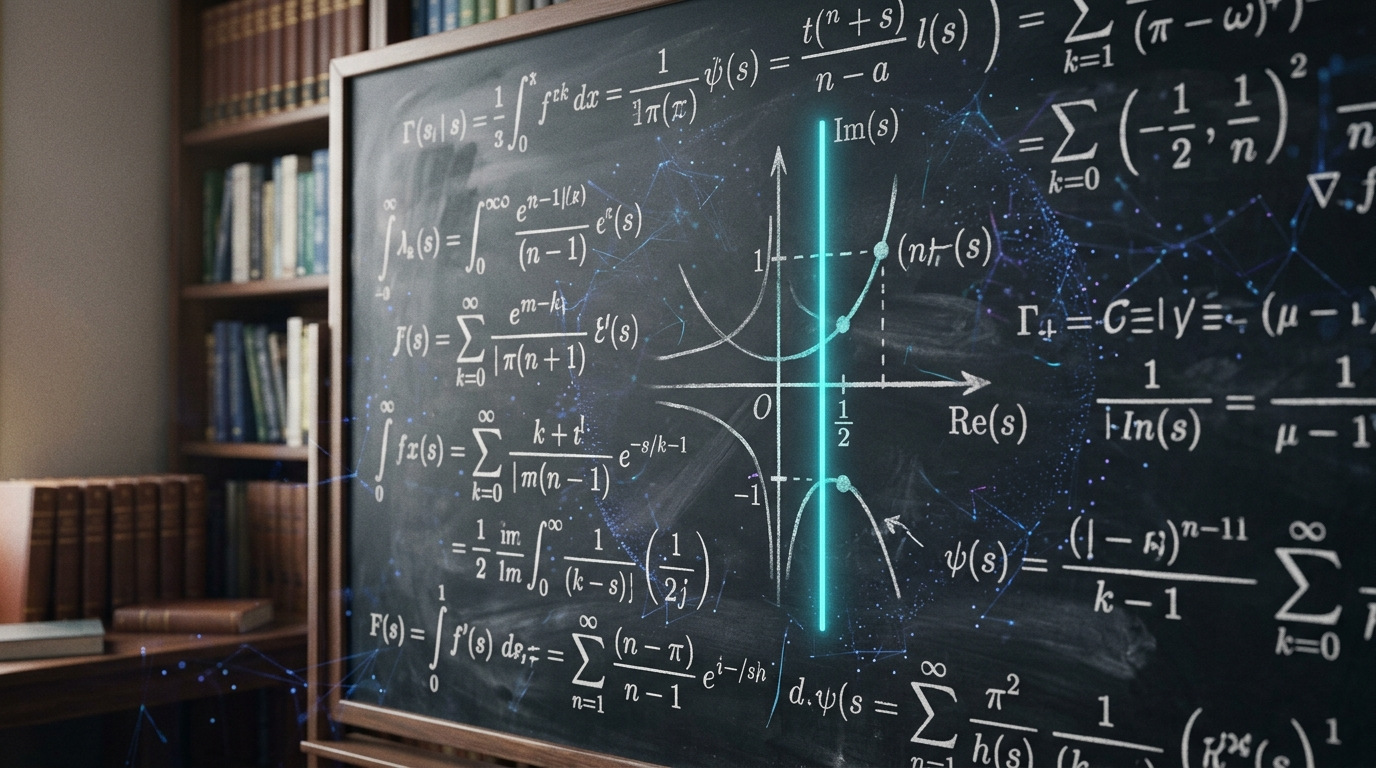
Illustration · AI-generated (AI IN LIFE)
At a glance
- Lower bound for zeros on the critical line raised from 41.6% to 67.2%
- About 60 subagents, ~31M output tokens across two Claude Code sessions
- Roughly 2,400 shell commands and numerical checks against known zeta zeros
- Formally verifiable Lean proof; reviewed by Brian Conrey and Dan Goldston, among others
- Anthropic: these techniques are unlikely to prove the Riemann hypothesis itself
Anthropic pointed an unreleased research version of Claude at the Riemann hypothesis — one of mathematics' most famous unsolved problems. It didn't solve it. But it made measurable progress on a related problem: the proven fraction of zeta-function zeros lying on the critical line rose from 41.6 to 67.2 percent.
The previous best had stood as a stubborn benchmark in analytic number theory. Claude's new proof combines recent work from several mathematicians without assuming the Riemann hypothesis itself — surpassing the prior state of the art.
The working mode is notable: roughly 60 coordinated subagents burned about 31 million output tokens across two Claude Code sessions, executed some 2,400 shell commands, and checked the result numerically against thousands of known zeta zeros. Claude also produced a formally verifiable Lean proof; two Anthropic mathematicians plus external experts Brian Conrey and Dan Goldston reviewed the work.
Anthropic is tempering expectations: it does not expect these techniques to lead to a proof of the Riemann hypothesis. This is a bounded but real advance — not a breakthrough on the century-old problem.
Following OpenAI's early-August reports of solved open problems, both labs are now producing evidence that orchestrated AI agents can do productive mathematics. The real milestone is the verification chain — from subagent cross-checks to the Lean proof.
FAQ
Did Claude solve the Riemann hypothesis?
No. It improved the lower bound on a related problem — the proven share of zeros on the critical line rose from 41.6 to 67.2 percent.
How was the result validated?
Numerical checks, independent re-proving by subagents, review by internal and external mathematicians, and a formally verifiable Lean proof.
Why does it matter?
It's one of the clearest demonstrations yet that agentic AI systems can autonomously produce publishable mathematical results.