Optical Computing Targets AI Inference Power Limits
Photonics startups Q.ANT, Lumai and Neurophos are shipping first light-based machines as the sector's market value hits $2.22 billion.
In short
Optical computing is returning to real data centers because AI inference has hit a power wall, with Q.ANT, Lumai, Neurophos and Lightelligence putting photonic processors into service — though analog-to-digital conversion still caps the gains.
At a glance
- Market value of optical computing companies: $2.22 billion, up from $0.4 billion in 2022.
- Cornell team in 2022: 2.5 × 10⁻¹⁹ joules per multiplication versus 10⁻¹⁴ to 10⁻¹² joules in digital chips.
- Peter McMahon puts the optical break-even at vector lengths of 1,000 to 10,000 elements.
- Q.ANT runs Native Processing Servers at LRZ Munich and the Jülich Supercomputing Centre.
- Neurophos claims 50x the speed of Blackwell B200, with rack deliveries targeted for 2028.
Optical computing is moving out of the lab because AI inference has run into a power ceiling: Q.ANT, Lumai, Neurophos, Lightelligence, LightSolver and Optalysys are all building processors that perform matrix multiplication in light rather than in transistors. IEEE Spectrum puts the combined market value of companies in the sector at $2.22 billion, up from $0.4 billion in 2022.
A 1978 idea, revived by the power bill
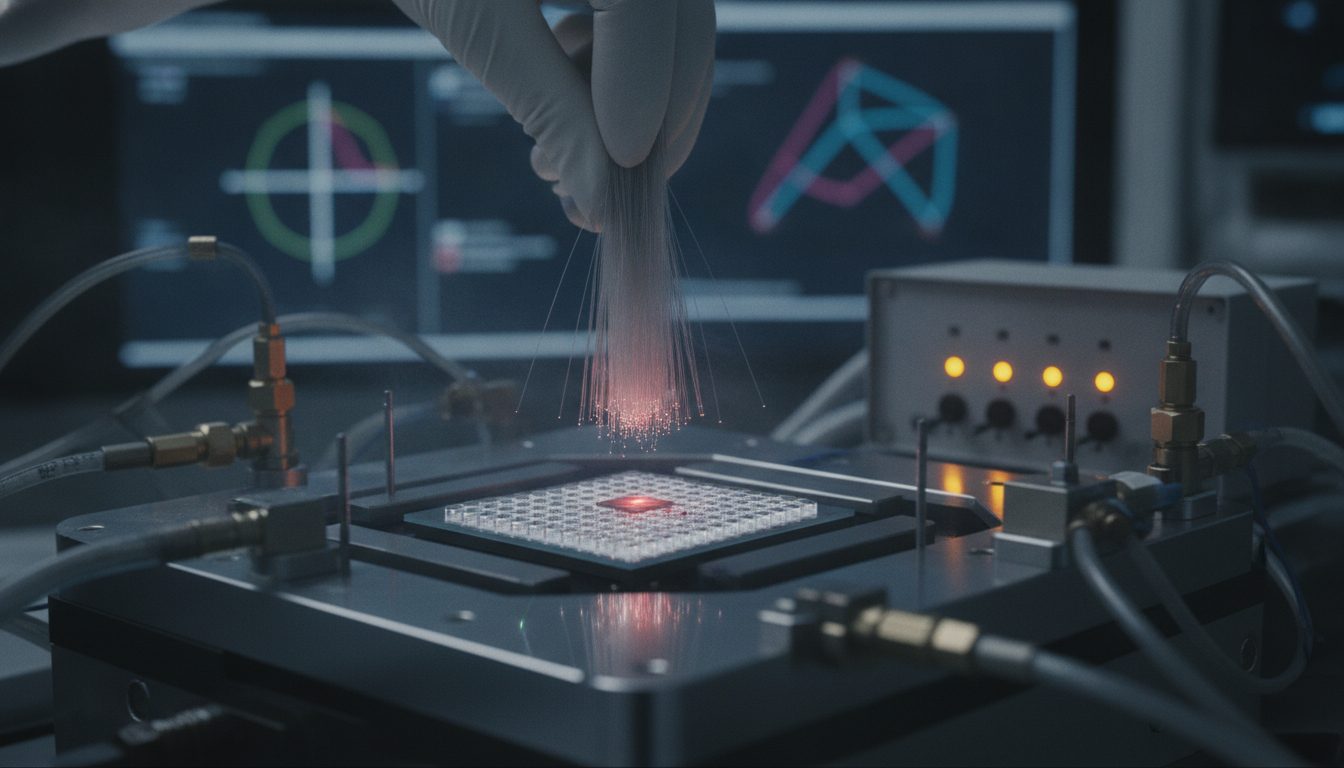
The underlying scheme dates to Joseph W. Goodman in 1978: encode a vector in LED brightness, stretch the light vertically with a cylindrical lens, pass it through an N×N grid of pixels that attenuate it by the matrix values, then collect the sums. The multiply itself costs almost nothing, because it is just light being dimmed. The expense sits around it, in getting data in and out.
Peter McMahon's group at Cornell University measured the floor in 2022: fewer than one photon, or 2.5 × 10⁻¹⁹ joules, per multiplication, against 10⁻¹⁴ to 10⁻¹² joules per operation in digital hardware. On paper that is a 100,000x gap, and McMahon cautions against carrying it straight over to a finished machine.
What is actually shipping
Q.ANT, based in Stuttgart, uses integrated photonics on silicon and has its Native Processing Server installed at the Leibniz Supercomputing Centre (LRZ) in Munich and at the Jülich Supercomputing Centre, plus a 2025 commercial sale to cloud provider Ionos. Lumai in Oxford took the free-space route with spatial light modulators: its Iris Nova has been available for evaluation since April 2026, and the company says the follow-on Iris Aura needs one-tenth of a GPU's energy during the prefill phase.
Neurophos in Austin packs 1,000 × 1,000 metamaterial modulators onto a 5-millimeter chip and claims 50x the speed and 35x the energy efficiency of Nvidia's Blackwell B200, with 250x and 90x on the road map and rack deliveries targeted for 2028. Lightelligence in Shanghai published 2025 results for PACE2, which handles 128 × 128 matrices at 1 gigahertz with 3-nanosecond latency, two orders of magnitude below typical GPUs. LightSolver in Israel runs a laser processing unit inside an optical cavity and reports 40 to 80,000 times GPU speed on differential equations — so far from emulation, not from silicon.
The catches
Optics only wins at scale. McMahon's rough break-even sits between vector lengths of 1,000 and 10,000; below that, the cost of encoding eats the advantage. Behind it lies the harder problem of conversion between analog light and digital bits: Q.ANT founder Michael Förtsch says that without fast, low-energy converters he sees no realistic path to general-purpose optical multiplication.
Amdahl's law has not been repealed either: accelerate 90 percent of a workload optically and the whole job still caps out around 10x. Logan Wright of Yale University adds that algorithm design currently tracks GPU strengths and need not keep favoring optics. Manufacturing is a wall of its own, since lens inspection and assembly typically hold free-space optical builds to roughly 1,000 units a year.
What this report does not establish
The speed and efficiency figures from Lumai, Neurophos and LightSolver are vendor claims or emulation results; the report carries no independent full-system benchmarks. This story rests on a single newsroom, IEEE Spectrum, and a second independent confirmation of the numbers was not available at publication. What is solid is that first units are installed at named operators — not that they displace GPUs at scale.
FAQ
What is optical computing?
Processors that encode numbers as light intensity and carry out matrix multiplication by attenuating and summing light instead of switching transistors. The arithmetic step itself consumes almost no energy.
Which companies build optical AI chips?
Q.ANT in Stuttgart, Lumai in Oxford, Neurophos in Austin, Lightelligence in Shanghai, LightSolver in Israel and Optalysys in Leeds. Q.ANT has systems running at supercomputing centers and Lumai offers an evaluation server.
Will optical chips replace GPUs?
Not on current evidence. Peter McMahon places the break-even at vector lengths of 1,000 to 10,000, analog-to-digital conversion remains a bottleneck, and Amdahl's law limits the overall gain.