Google Adds TPU 8tx and TPU 8i Max to Its Lineup
Two more eighth-generation TPU systems: 8i Max doubles compute and HBM bandwidth, while 8tx isolates data and weights inside the hardware.
In short
Google has added two systems to its eighth-generation TPU family: TPU 8i Max doubles compute, SRAM and HBM bandwidth over TPU 8i, while TPU 8tx runs confidential inference behind a security boundary built into the hardware itself.
At a glance
- TPU 8i Max combines two TPU 8i chips on one package: double the compute, double the SRAM, double the HBM bandwidth.
- Same rack footprint, twice the silicon per sled.
- TPU 8tx reuses the TPU 8t silicon, paired with 5th-generation AMD EPYC CPU hosts.
- Google claims up to 2x lower latency for TPU 8tx than TPU 8t, with near-zero performance penalty.
- Four TPU systems in one year; Google cites nearly 100 customers, from frontier labs to trading firms.
Google has expanded its eighth-generation TPU family with two more systems: TPU 8i Max, aimed at inference over very long contexts, and TPU 8tx, aimed at confidential inference where data and model weights stay walled off in hardware during processing. Both sit alongside TPU 8t and TPU 8i, which Google introduced at Cloud Next in April 2026.
8i Max packs two chips into one
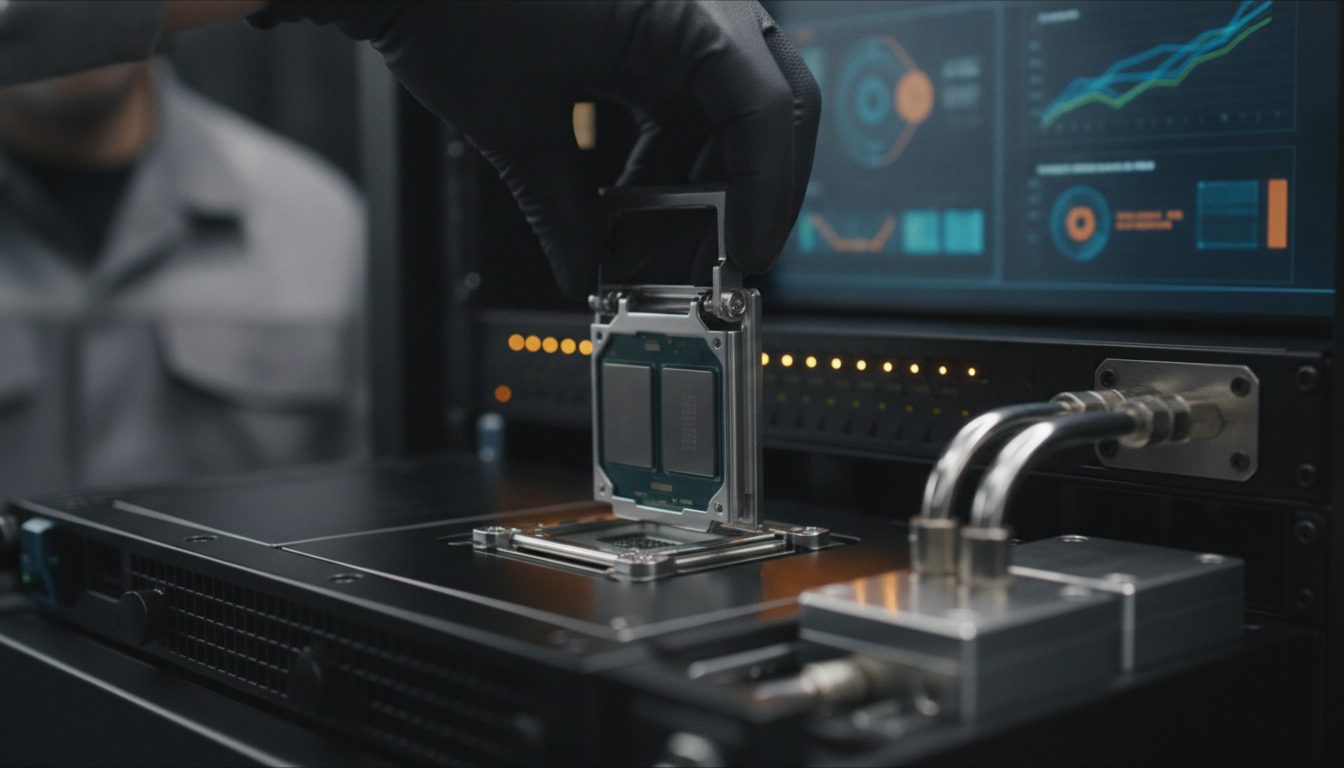
Google describes TPU 8i Max as a dual-chip system that brings two TPU 8i chips onto a single package. Against one TPU 8i, that yields double the compute, double the SRAM and double the HBM bandwidth. The rack footprint does not change, so the same sled carries twice the silicon.
The bottleneck Google points at is memory bandwidth rather than raw math. When several agents hold an entire codebase — or hours of video — in context at once, the processors sit idle waiting on data instead of reasoning. Google uses million-token context windows, the scale its own Gemini model handles, as the reference point.
8tx moves the trust boundary into silicon
TPU 8tx is built on the same silicon as the TPU 8t training system, paired with 5th-generation AMD EPYC CPU hosts. Google states the gap plainly: data is encrypted at rest and in transit, but has to be unlocked in memory for a processor to work on it. On TPU 8tx, the company says sensitive data and model weights stay "protected and isolated even while in active use." SiliconANGLE characterizes the mechanism as a hardware-level secure enclave.
The named audience is regulated enterprises, governments, companies running proprietary models, and agents that touch sensitive records. Google quotes up to 2x lower latency than TPU 8t, with what it calls a near-zero performance penalty for the isolation. It also positions 8tx as workable for smaller-scale training, not inference alone.
Four systems inside twelve months
With 8tx and 8i Max, Google says it has announced four TPU systems in a single year for the first time. For the earlier pair it cites up to 2.7 times better training performance on TPU 8t and 80 percent better inference price-performance on TPU 8i, each against the prior generation. On adoption, the company points to nearly 100 customers spanning frontier labs, trading firms, retailers and universities.
Google pairs the hardware with software numbers: TPU Sync cuts KV-transfer latency by more than 90 percent, jobs start up to 5x faster, and fault recovery runs up to 4.5x faster. A TPU agent suite is in preview, while Cloud Pathways and dynamic slicing in GKE are generally available.
What is not established
Neither readable source gives availability dates or pricing for TPU 8tx and TPU 8i Max, so when and where customers can rent them remains unverified. Every performance figure above is a vendor claim; no independent measurements exist yet. A third trade outlet covering the announcement was unreachable at publication time (HTTP 403) and is therefore not cited here.
FAQ
What is the difference between TPU 8i and TPU 8i Max?
TPU 8i Max puts two TPU 8i chips on one package, which Google says delivers double the compute, double the SRAM and double the HBM bandwidth within the same rack footprint.
What is TPU 8tx for?
Confidential inference. Google says data and model weights stay isolated in hardware even while being processed, targeting regulated enterprises, governments and operators of proprietary models.
When will TPU 8tx and TPU 8i Max be available?
Google gave no date and no pricing in the announcement, so availability and regional rollout are not established at this point.