Gemini 4 Argon Robotics Model Hits 87% on ERQA
Google's physical reasoning model drives grippers and legged robots, rebuilds scenes as simulations, and ships on the paid Gemini API tier today.
In short
Gemini 4 Argon is Google's new physical reasoning model: it scores 87 percent on the ERQA embodied reasoning benchmark, writes control code for robot arms and legged platforms, and is live on the paid Gemini API tier.
At a glance
- ERQA benchmark for 3D physical problems: 87 percent, which Google calls the best score among the frontier models it tested.
- Access: Google AI Studio and Google Antigravity for AI Ultra subscribers, Gemini API paid tier, model ID gemini-4-argon.
- Demos span Boston Dynamics Spot, dual-arm Franka FR3, ALOHA 2, ANYmal C, Go2, G1 and a 76-degree-of-freedom humanoid.
- Real-to-sim: Argon rebuilds simulation twins from robot camera feeds, human video and sketches.
- In GitHub Copilot since October 13, 2026 for Pro+, Max, Business and Enterprise, billed at provider list pricing.
Gemini 4 Argon is Google's new physical reasoning model. DeepMind reports 87 percent on the ERQA embodied reasoning benchmark, and the model writes control code for robot arms and legged platforms. It is available now on the paid Gemini API tier.
Reasoning about objects, not sentences
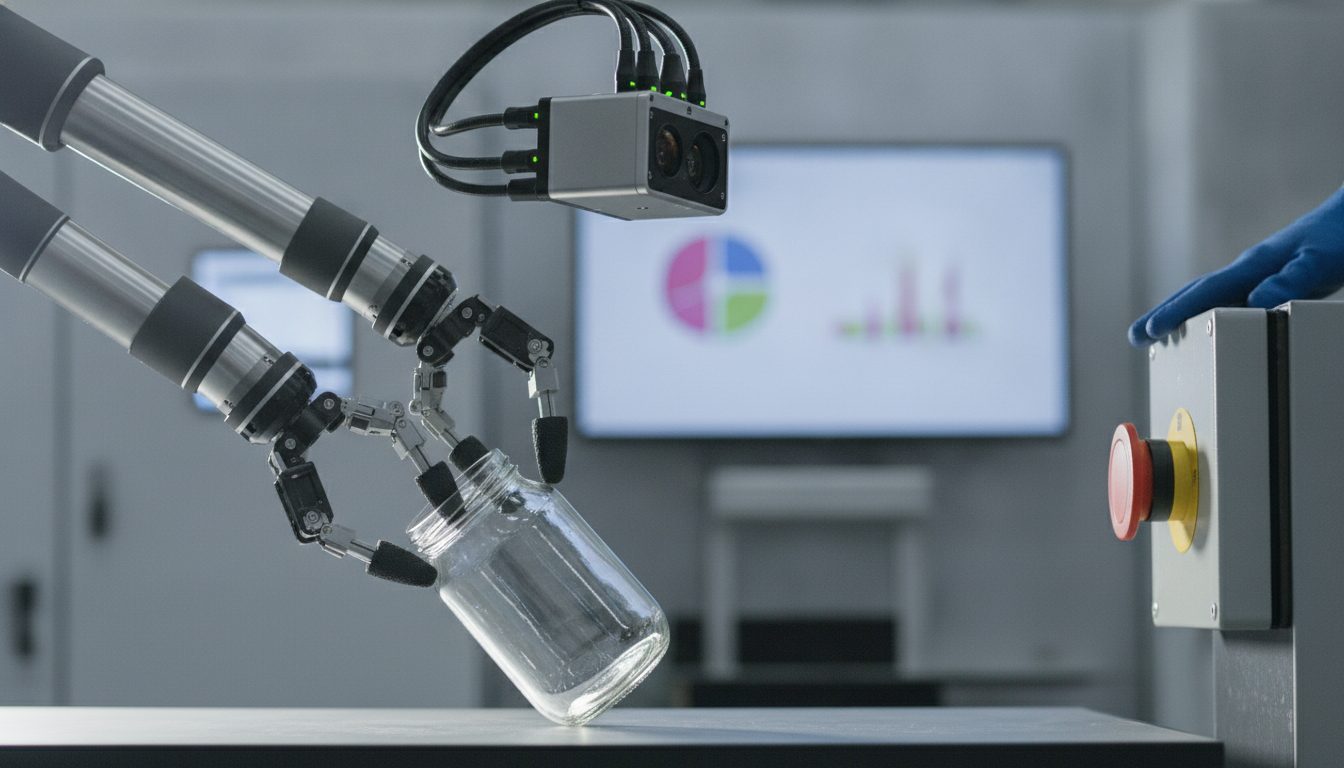
Google positions Argon as a general-purpose model for physical and 3D spatial reasoning. It is meant to read spatial relationships out of images and video, split a task into steps, and emit the control code that executes them. A closed visual feedback loop lets it adjust a grasp while the grasp is still happening, rather than planning the motion once and hoping.
The second pillar is real-to-sim. Argon reconstructs a simulation twin of a scene from robot camera feeds, ordinary human video, or even a sketch, so a motion can be rehearsed before hardware moves. Google runs the same loop in its research demos to refine actions in simulation, generate hindsight labels, and estimate value functions.
The hardware in the demos
The clips do not stay on one in-house platform. Google shows Boston Dynamics Spot, a dual-arm Franka FR3, ALOHA 2, UMI grippers, the ANYmal C and Go2 quadrupeds, the G1 humanoid, OP3 soccer robots, and a 76-degree-of-freedom humanoid whose hands alone carry 22 degrees of freedom.
Breadth is the claim: one model steering arms zero-shot, without per-platform training. What the post does not publish is a success rate for any individual robot or task.
What 87 percent does and does not prove
ERQA measures whether a model understands 3D physical problems, not whether a machine completes them on a bench. Google reports 87 percent and calls it the strongest result among the frontier models it tested, without listing the competing scores. The distance between a benchmark number and a robot cleared to work beside people is a safety-approval question the announcement leaves untouched.
The same model, a different desk
Argon also reached GitHub Copilot on October 13, 2026, as a gradual rollout for Copilot Pro+, Max, Business and Enterprise. It shows up in the model picker in Visual Studio Code, Visual Studio, JetBrains IDEs, Xcode, Eclipse, the Copilot CLI, the Copilot app, and the Copilot coding agent.
GitHub says early testing had the model solving more tasks than earlier Gemini releases on every coding benchmark it ran, with the biggest jump in the Copilot CLI. Usage is billed at provider list pricing under usage-based billing, and Business or Enterprise admins can switch the model off in Copilot model policy.
Open questions
Three things stay unverified across both posts: per-task success rates for the manipulation demos, feedback-loop latency on real hardware, and any detail on how the system is kept safe around people. Those are gaps, not solved problems, and worth treating as such in any deployment plan.
FAQ
What is Gemini 4 Argon?
A Google model for physical and spatial reasoning. It interprets 3D scenes from images and video, breaks a task into steps, and generates control code for robots to run.
Which Copilot plans include Gemini 4 Argon?
Copilot Pro+, Max, Business and Enterprise, rolling out gradually from October 13, 2026. Usage is billed at provider list pricing, and admins can disable the model in Copilot model policy.
Can Gemini 4 Argon control a real robot?
Google demonstrates it on platforms including Boston Dynamics Spot, a dual-arm Franka FR3 and the G1 humanoid, but publishes no per-task success rates and no detail on safety clearance for work around people.