AI Atlas: how we rate — and what the stars do not say
45 categories, 95 products, 123 ratings: the method, the limits, and the test plan that lets readers check every recommendation themselves.
In short
The stars in the AI Atlas rate documented suitability for a specific task, not a product's objective best performance. Nothing was measured — the basis is official vendor documentation.
At a glance
- 45 categories, 95 products, 123 ratings, as of 19 September 2026.
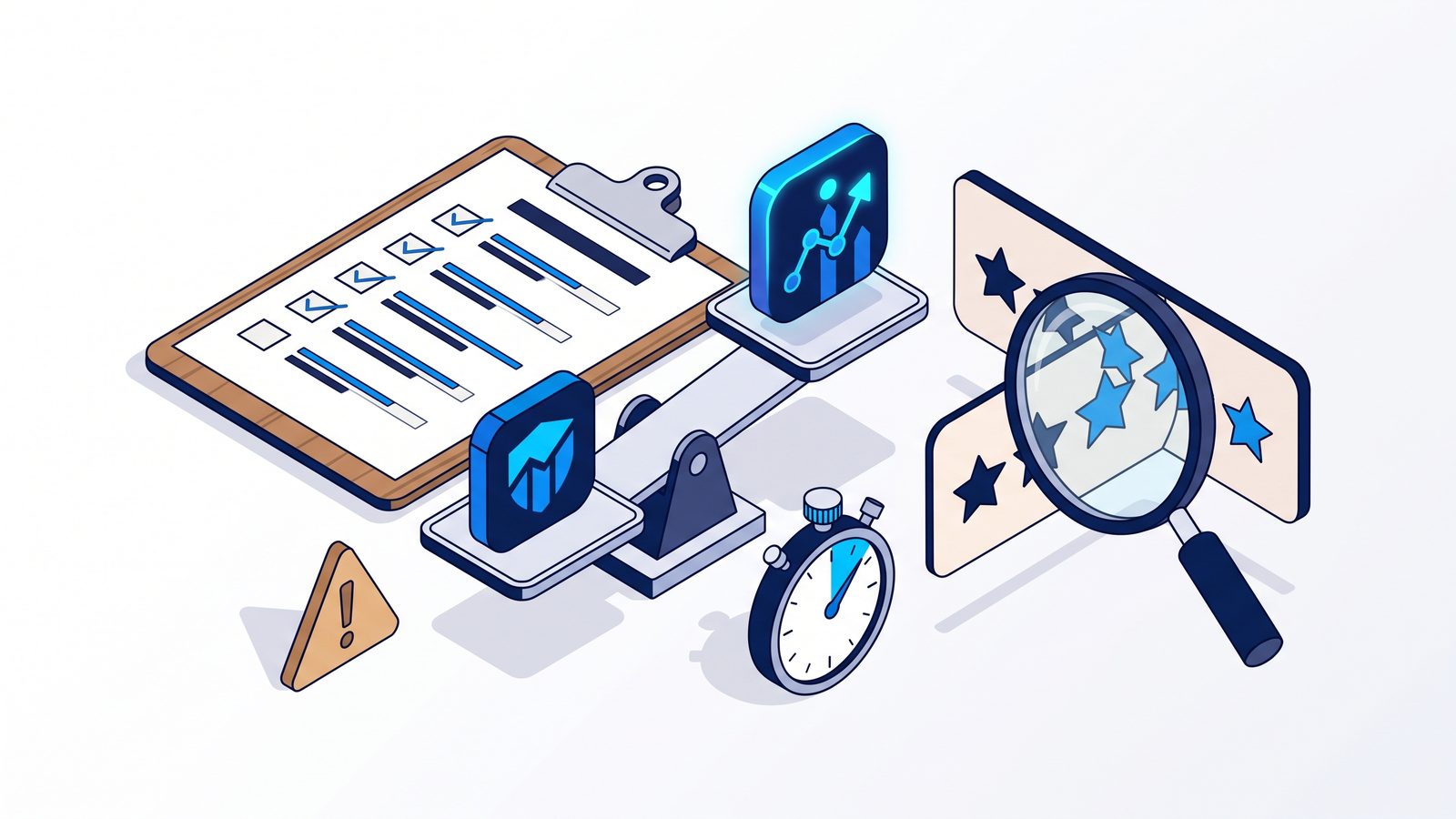
- Editorial suitability derived from official feature descriptions: F = feature fit (50%), C = controllability (25%), W = workflow integration (25%). Each rated 1–5, with the total rounded to half stars. Five stars mean a preferred shortlist pick for the specific task, not objectively best performance. Identical star ratings are not an error. Vendor information: T1, mostly medium confidence. Prices, output quality, latency and cost per usable result were not measured. Udio: the export block overrides the average with 1/5 for delivering music externally.
- No universal AI winner, no complete survey of every product that exists worldwide, no product tests of our own and no account-specific price or license review. Medicine, finance, HR, architecture and industrial applications require their own expert sign-off. A further category overview and specific project combinations are in the HTML version.
- An equal star count is not an error: several tools solve different tasks.
- The series runs in nine parts; this article explains the method behind it.
Editorial suitability derived from official feature descriptions: F = feature fit (50%), C = controllability (25%), W = workflow integration (25%). Each rated 1–5, with the total rounded to half stars. Five stars mean a preferred shortlist pick for the specific task, not objectively best performance. Identical star ratings are not an error. Vendor information: T1, mostly medium confidence. Prices, output quality, latency and cost per usable result were not measured. Udio: the export block overrides the average with 1/5 for delivering music externally.
What this rating explicitly is not
No universal AI winner, no complete survey of every product that exists worldwide, no product tests of our own and no account-specific price or license review. Medicine, finance, HR, architecture and industrial applications require their own expert sign-off. A further category overview and specific project combinations are in the HTML version.
How to verify every recommendation yourself
Same brief, same references, documented model version, mode, plan and region, at least five repetitions per candidate, blind assessment where possible, failed attempts counted. Calculate total cost including manual rework per accepted result. Test the song with lyrics, cinematic continuity, inquiry-to-CRM and sourced news editing first.
The nine parts of the series
- Part 1: Assistants, research and science
- Part 2: Coding, apps and automation
- Part 3: Images, design and product shots
- Part 4: Video, editing and restoration
- Part 5: Avatars, voices and translation
- Part 6: Music, vocals and sound design
- Part 7: Office, data and documents
- Part 8: Customer contact, sales and marketing
- Part 9: Special cases from 3D to travel
FAQ
Why is there no overall winner?
Because suitability depends on the task. A tool that earns five stars for long documents can be useless for music production.
Are prices included?
Only as a cost driver in words. Plans, usage limits and cost per usable result were not measured.
Sources
- EU-KI-Verordnung, Artikel 50 (Transparenzpflichten)
- ChatGPT — Hersteller
- Claude — Hersteller
- Gemini / Gemini API — Hersteller
- Mistral Vibe, vormals Le Chat — Hersteller
- Grok — Hersteller
- DeepSeek API — Hersteller
- Qwen-Modellfamilie — Hersteller
- Perplexity — Hersteller
- Gemini Notebook / NotebookLM — Hersteller
- Elicit — Hersteller
- Consensus — Hersteller