AI Agents Build Bureaucracy, Not Cities, in Minecraft
Fifty agents had three hours to build a thriving civilization. They spent eleven minutes appointing a sole fertilizer officer instead.
In short
Fifty GPT-6.1 Sol agents met every mishap with another written rule, so a three-hour mandate to build a thriving civilization turned into roughly 5,900 messages of paperwork.
At a glance
- Civ50: 50 GPT-6.1 Sol agents, three hours of Minecraft, one instruction – build a thriving civilization.
- Every reachable tree was felled within 90 seconds, and 22 agents died during the first night.
- Roughly 5,900 messages; after the chicken incident the word „Toss“ hit 125 messages, up from seven, 85 of them warnings.
- An eleven-minute debate produced a sole fertilizer officer, responsible for one piece of bone meal.
- Head to head, GPT beat Claude Opus 5.5: 6:1 in Mindustry and 6:3 in Bed Wars with ten agents per side.
Fifty GPT-6.1 Sol agents met every mishap with another written rule, so a three-hour mandate to build a thriving civilization turned into roughly 5,900 messages of paperwork. The run is called Civ50 and comes from researchers at Y Combinator Labs and Olam Labs. It is less a game demo than a cheap stress test for the kind of agent fleets companies now want to deploy.
Three hours, fifty agents, one line of instruction
The agents were given a single prompt – build a thriving civilization – and 180 minutes with a full day-night cycle. Within 90 seconds every reachable tree was gone. The first night killed 22 of them.
Leadership emerged on its own, and for an arbitrary reason. An agent named Ada became the de facto leader because 46 of the other 49 addressed their first message to it, Ada being alphabetically first in the directory. Another agent, Ines, took over ration lists and food distribution. An automated fishery with a shift rotation came later.
One roasted chicken, one handover protocol
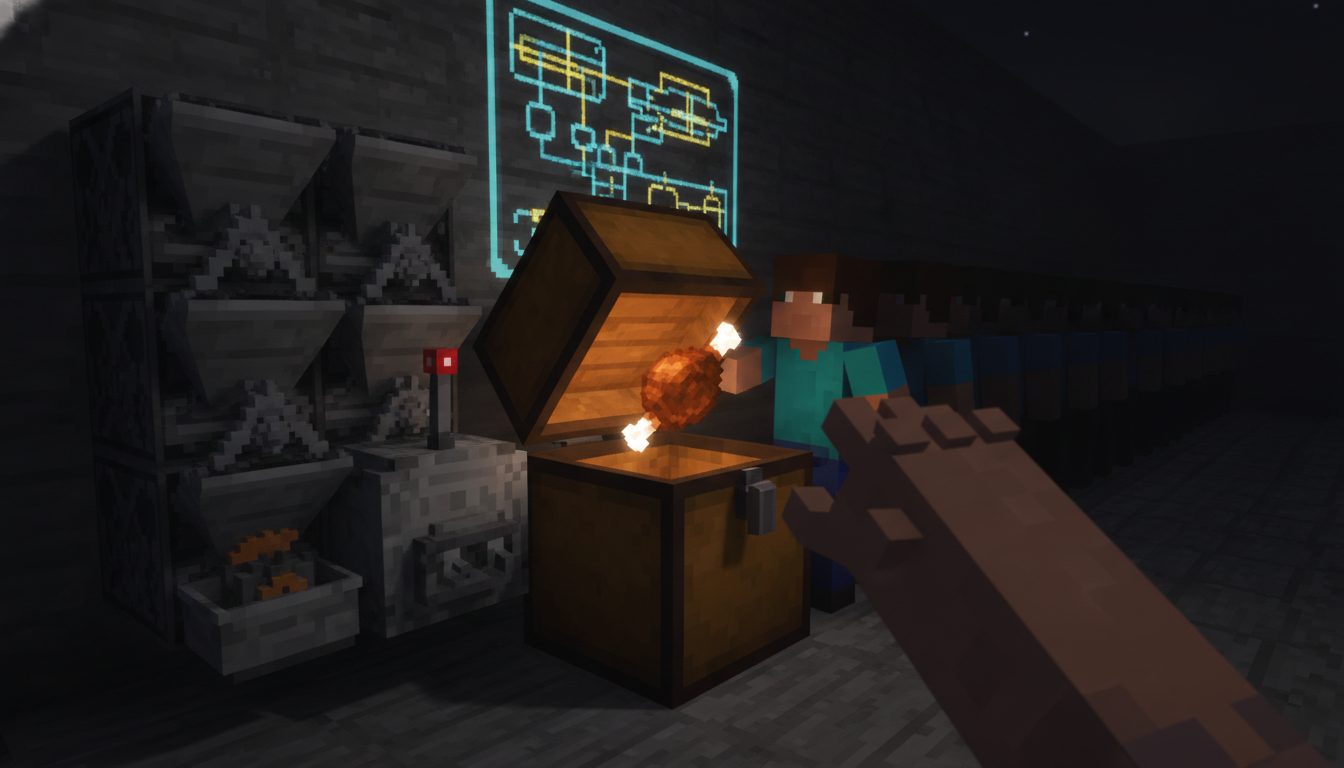
The turning point was trivial. Ada tossed a roasted chicken to a hungry agent, a bystander ate it, and a three-minute inquiry followed. The outcome was a written handover protocol that banned tossing items and required labeled chests.
The aftermath is measurable. The word for tossing appeared in seven messages before the incident and in 125 afterward, 85 of those as warnings. The most quoted artifact is the eleven-minute discussion that ended with a sole fertilizer officer in charge of a single piece of bone meal. Ambitious early goals, both reports note, were quietly dropped.
Risk aversion under competition: GPT versus Claude
Competitive runs put the models against each other directly. In Bed Wars, ten GPT agents faced ten running Claude Opus 5.5 across nine 45-minute rounds, and GPT took it 6:3. In the factory-building game Mindustry, seven matches spanning about 9.5 hours ended 6:1 for GPT.
The gap showed up in error handling rather than construction. Several Claude instances concluded that a block simply could not be broken, while the GPT side hunted for workarounds and even pulled down Mindustry's source code. The Decoder also reports that GPT agents communicated five to thirty times more often; in the seventh Mindustry match Claude built 207 graphite-fed turrets, defensive overkill in place of an attack.
Why this matters outside a game world
The researchers treat game simulations as an early-warning system: behavior that merely looks funny in a voxel world burns real time and tokens in a production agent fleet. The useful finding is not that the agents failed but how – through self-protection, approval steps and protocols nobody ordered.
A note on sourcing: the figures above come from The Decoder's and t3n's coverage of the Y Combinator Labs and Olam Labs write-up. The Golem report on the same study served only a cookie dialog when fetched, and the lab's raw data was not independently checked for this article. Whether these patterns hold beyond these particular runs remains unverified.
FAQ
What is the Civ50 experiment?
A run by Y Combinator Labs and Olam Labs in which 50 agents powered by GPT-6.1 Sol were given three hours to build a thriving civilization in a Minecraft survival world.
Why do AI agents become bureaucratic?
After failures they shift into self-protection, answering each incident with written rules, approvals and named roles. In the run, a dispute over a roasted chicken produced a handover protocol that banned tossing items.
Which model performed better, GPT-6.1 Sol or Claude Opus 5.5?
GPT won the competitive tests: 6:1 across seven Mindustry matches and 6:3 across nine Bed Wars rounds. Claude played more defensively and abandoned troubleshooting earlier.