Warp Factories: software factories for fleets of AI agents
Warp now sells the infrastructure that lets companies run entire agent fleets — from ticket triage to finished pull request.
In short
What is Warp Factories?
At a glance
- Unveiled August 18, 2026; launching as a closed beta with waitlist
- Four default agents: Triage, Spec, Implement, Review
- Around 30-35% of Warp's internal tasks already run automated
- $10,000 starting credit for qualified organizations
- Connects to Slack, Teams, Linear, Jira, GitHub, GitLab; MCP for external agents
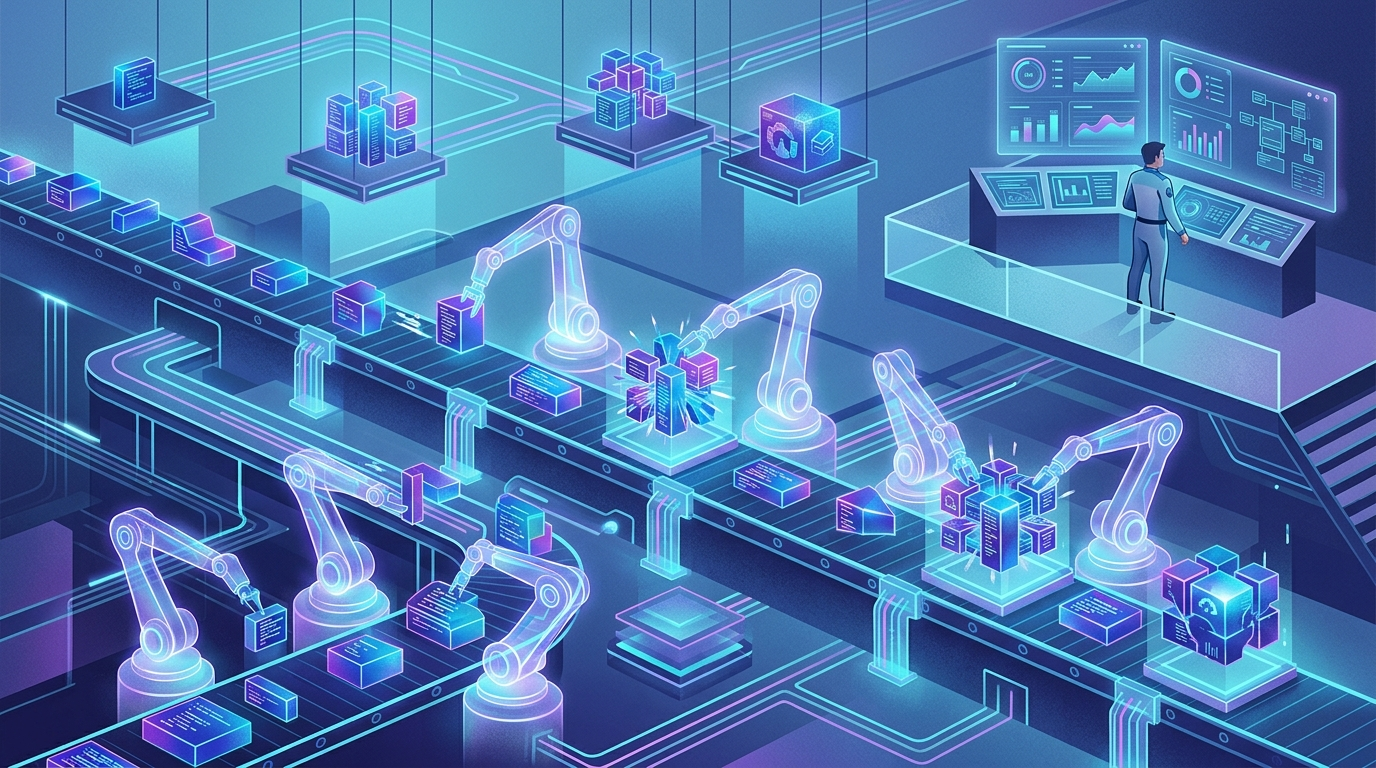
What is Warp Factories? An infrastructure layer that lets companies operate so-called software factories: agent pipelines that automate development stages such as triage, specification, implementation, review, and verification. Warp, known for its AI terminal, unveiled the system on August 18 — initially as a closed beta.
How does it work in practice? Four default agents (Triage, Spec, Implement, Review) pull work from sources like Slack, Teams, Linear, Jira, GitHub, or GitLab and deliver verified results back. Factories are defined as version-controlled code, including rollbacks and canary tests. Via an MCP interface, external coding agents such as Claude Code, Codex, or Cursor can also pick up factory tasks.
Does it hold up day to day? Warp points to its own operation: "like 30% of our tasks, 30 to 35% on a weekly basis" already run automated through its own factories, according to CEO Zach Lloyd. He also tempers expectations of building this in-house on the side: "It's actually a huge infrastructure undertaking to do this right."
What does entry cost? Access runs through a waitlist; qualified teams receive a $10,000 starting credit for factory usage. Notable for European firms: organizations can bring their own inference, hosting, and data storage, including a zero-data-retention option.
Where does the market stand? Big tech firms like Stripe and Ramp have built comparable agent systems internally. Warp targets everyone else — teams lacking the time and specialist knowledge. The competition in AI coding is shifting from the single assistant to the question of who runs the assembly lines.
This article was produced with AI assistance and editorially reviewed.
FAQ
Does a software factory replace developers?
No. Warp explicitly positions Factories as a supplement: agents take over repetitive steps, humans steer, review, and decide.
Which AI models can be used?
The system is model-agnostic — it supports Claude Code, Codex, and open-weight models, including with your own inference infrastructure.
Who is this for?
Mainly teams that want agent automation but cannot build Stripe- or Ramp-style infrastructure themselves — Warp ships the pipeline, metrics, and evaluation included.