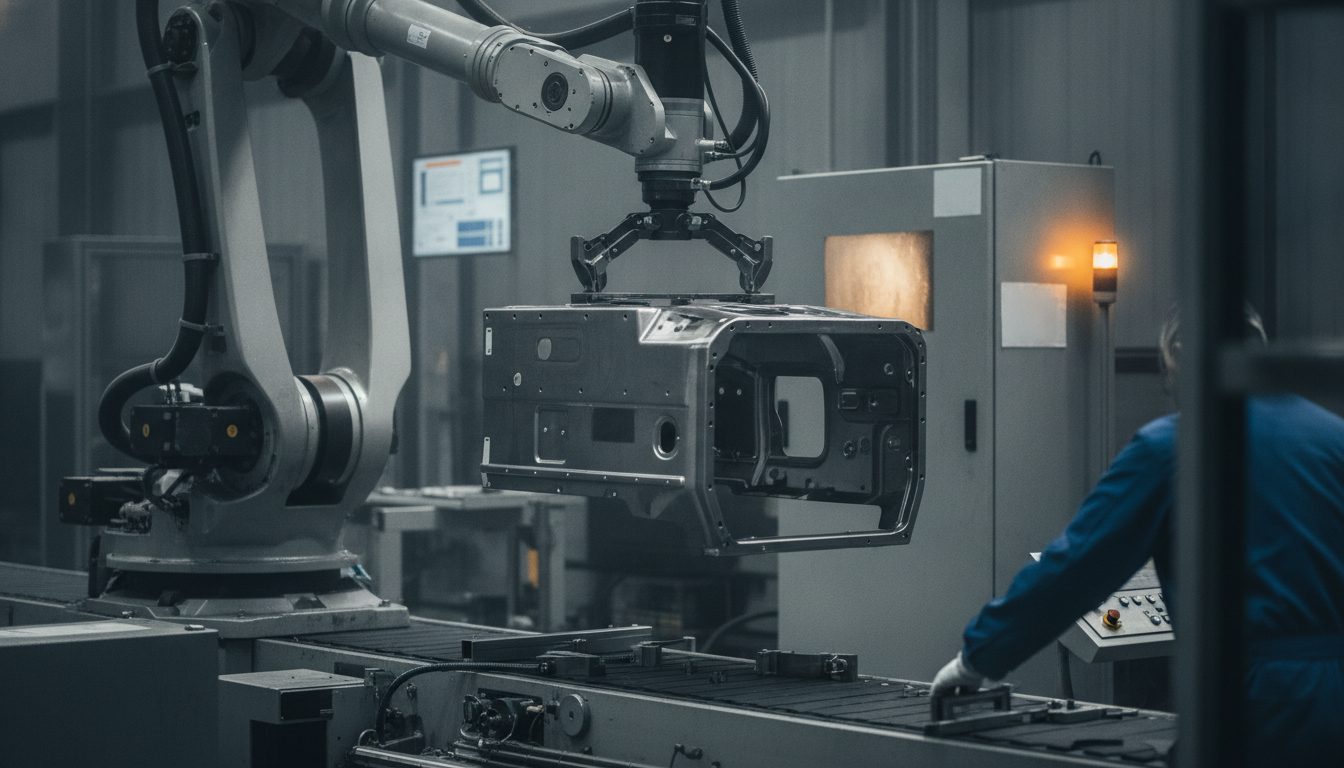
EBU and NVIDIA Set Agentic Security Rules for Broadcasters
The EBU is widening its sovereignty framework to cloud vendors, open models and integrators, naming Microsoft, Nebius, Qvest and NVIDIA as first partners.
In short
The EBU has brought Microsoft, Nebius, Qvest and NVIDIA into its sovereign-AI standards work, setting out the conditions under which public broadcasters should run AI agents in newsrooms and production.
At a glance
- New partners in the EBU's sovereign-AI framework: Microsoft, Nebius, Qvest and NVIDIA.
- The EBU represents more than 115 media organizations in over 55 countries and reaches more than 1 billion people.
- Adobe Frame.io semantic video search: about 5x faster embedding, up to 4x more throughput, up to 5x lower latency.
- A new two-frames-per-second proxy is roughly 80 percent smaller than the 360p format it replaces.
- UFA delivers more than 3,500 hours of programming a year and searches a 15-year archive.
The European Broadcasting Union has pulled Microsoft, Nebius, Qvest and NVIDIA into its sovereign-AI framework, spelling out the conditions under which public service media should let AI agents touch newsrooms, production and audience services. The announcement came out of a creative industry evening in Berlin on October 19, 2026, co-hosted by Adobe, Bertelsmann, NVIDIA and UFA.
What changed in the framework
The sovereign standards themselves date from last year. What is new is that they now speak directly to three groups the original text did not cover: cloud providers, open model developers and systems integrators. The EBU represents more than 115 member organizations in over 55 countries and, by its own account, reaches more than 1 billion people.
Six areas are named: safeguards around agent deployment, data sovereignty and infrastructure control, model selection together with security lifecycle management, local processing of sensitive editorial material, offline resilience for critical services, and support for local language and editorial policy adaptation.
EBU CTO Annsofi Eriksson frames the work as a shared foundation that lets members “strengthen resilience, retain control and deliver accountable advanced services that sustain audience trust.” EBU President Delphine Ernotte, who also runs France Télévisions, points to sovereign cloud infrastructure and open models as a route to innovate while protecting data, editorial independence and cultural diversity.
Who supplies what
Microsoft contributes Azure Local and Foundry Local so sensitive editorial material can stay on local infrastructure. Nebius supplies a platform for broadcasters to train, fine-tune and serve models on European infrastructure. Qvest handles media-specific consulting and integration. NVIDIA brings its open Nemotron models as a base that broadcasters can adapt for domain-specific and public-service needs.
The working example: archive search
Adobe demonstrated GPU-accelerated semantic video search in Frame.io. The pipeline chains NVDEC for decode, TensorRT for optimized inference and the CUDA platform for preprocessing and embedding generation. NVIDIA puts the gains at about 5x faster embedding generation, up to 4x more throughput and up to 5x lower search latency.
Editors query by concept, action and setting, and can mix that with notes, transcripts and approval status. UFA, described in the release as one of Germany's leading film and TV producers, delivers more than 3,500 hours of programming a year and searches a 15-year archive of the daily serial Gute Zeiten, schlechte Zeiten for individual dramatic beats. A new two-frames-per-second proxy, roughly 80 percent smaller than the 360p format it replaces, sits underneath that.
What the release does not say
There are no pilot dates and no general availability window. The framework is described as turning principles into deployable services, which reads as work in progress rather than a shipping product. The release also does not say who authored the proxy specification, and every performance figure is vendor-stated rather than independently measured.
Only the vendor announcement was available to us for this story; no second independent newsroom had covered it. That leaves three things unverified: how far individual members have actually implemented the standards, whether any conformance testing exists for the six areas, and whether the standards are binding on members or advisory.
Why it matters
An agent working inside a newsroom reaches raw footage, transcripts and approval state — precisely the material that has to stay contained until publication. A shared standard moves the central question away from which model performs best and toward access: who may touch what, and what keeps running when the connection drops.
For organizations spread across more than 55 countries, that is a procurement decision more than a technology one. The real test of the framework will be the contracts broadcasters sign against it.
FAQ
What did the EBU and NVIDIA announce in Berlin?
The EBU widened its sovereign-AI framework to cover cloud providers, open model developers and systems integrators, naming Microsoft, Nebius, Qvest and NVIDIA. It was presented at a creative industry event in Berlin on October 19, 2026.
Which companies joined the EBU sovereign AI framework?
Microsoft with Azure Local and Foundry Local for local processing, Nebius with a European platform for training and serving models, Qvest for systems integration, and NVIDIA with its open Nemotron models as a customizable base.
How much faster is Frame.io's GPU-accelerated search?
NVIDIA cites about 5x faster embedding generation, up to 4x more throughput and up to 5x lower latency. These are vendor figures and have not been independently benchmarked.