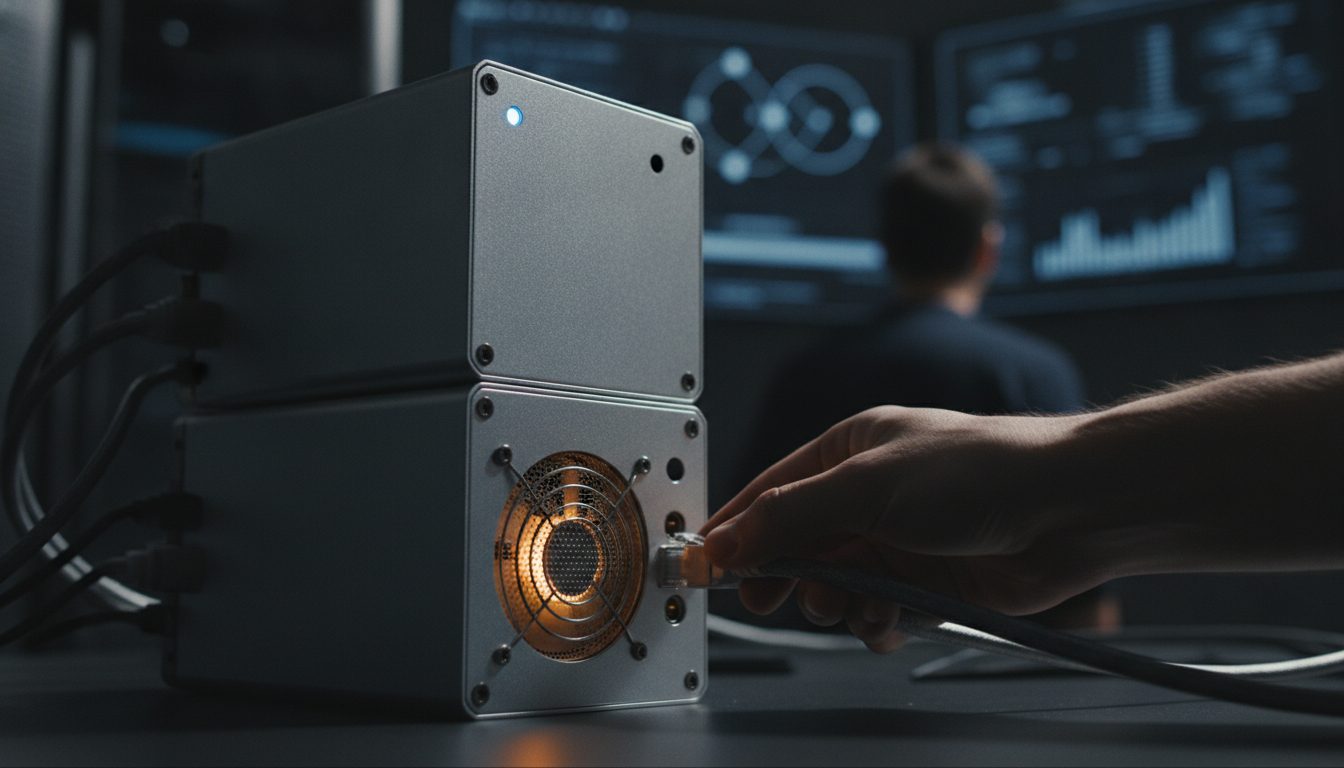
Timestral: Mistral's Time-Series Models Run on CPUs
Mistral released four forecasting models from 5 to 209 million parameters under a modified MIT license, built to run on server CPUs.

In short
Timestral is Mistral's first family of time-series foundation models — four sizes from 5 to 209 million parameters that, per the vendor, produce probabilistic forecasts on CPUs under a modified MIT license.
At a glance
- Four sizes: 5M, 28M, 123M and 209M parameters, with a context window of 32,768 time steps.
- Output is probabilistic: 21 quantiles, multivariate targets plus past-only and known-future covariates.
- Mistral ranks the 209M model first on GIFT-Eval (83 entries), TIME (35) and fev-bench (37).
- CPU latency on 8 threads: 10 ms for the 5M model, 140 ms for the 209M, forecasting one day from three weeks.
- Modified MIT license; on-prem, VPC or air-gapped deployment; fine-tuning via Mistral Forge.
Mistral shipped Timestral on October 15, 2026, its first model family built for forecasting rather than language. The four checkpoints — 5M, 28M, 123M and 209M parameters — return probabilistic, multivariate forecasts, and the company's pitch is that they do it on a server CPU instead of a GPU.
What goes in, what comes out
Each model accepts up to 32,768 time steps of history and answers with 21 quantiles rather than a single number, which is what makes the output usable for risk thresholds. Inputs include multivariate targets plus covariates that are either past-only or known in advance, such as a scheduled maintenance window.
Mistral credits three design choices: decoupled horizon forecasting, covariate-aware attention, and a synthetic-first recipe that pre-trains on generated series before post-training on a mix of real and synthetic data.
The benchmark claims
By Mistral's own measurement, the 209M model takes the top spot on GIFT-Eval with 83 entries, TIME with 35 entries and fev-bench with 37 entries, using two-thirds of the parameters of the previous leader.
The smaller checkpoints carry the practical argument. Mistral says the 28M model beats Chronos-2, which is four times its size, and that the 123M model lands within 0.2 percent of the 209M score at 75 percent of the latency. TimesFM-3 and Falcon-2.0 are also named as models the 209M beats with fewer parameters.
Latency is the deployment story
On an eight-thread server CPU, Mistral reports 10 milliseconds for the 5M model and 140 milliseconds for the 209M model to forecast one day from three weeks of history, with the 28M model running five times faster than the 209M. That gap is the difference between scoring a handful of assets and scoring thousands on hardware a plant already owns.
The named use cases follow from that: industrial sensor forecasting and anomaly detection, maintenance and capacity planning, and financial flows, volumes and volatility. Deployment can be on-prem, in a VPC or air-gapped, and fine-tuning runs through Mistral Forge.
Unverified at press time
Every figure above comes from Mistral's launch post. The technical report is promised but not yet published, so the three first-place rankings have no independent replication we were able to check.
The license wording is the other gap. A modified MIT license is not MIT, and the announcement does not spell out what the modification restricts — read the text in the repository before planning a commercial deployment.
FAQ
What is Mistral Timestral?
Timestral is Mistral's first family of time-series foundation models, published on October 15, 2026 in four sizes of 5, 28, 123 and 209 million parameters. Each one returns probabilistic forecasts as 21 quantiles rather than a single predicted value.
Can Timestral run without a GPU?
Yes, according to Mistral. On an eight-thread server CPU the company reports 10 milliseconds for the 5M model and 140 milliseconds for the 209M model to forecast one day from three weeks of history. Those are vendor numbers, not third-party measurements.
What license is Timestral released under?
Mistral describes the license as a modified MIT. That is not the standard MIT license, and the announcement does not say what the modification changes, so check the license file in the repository before committing to a commercial deployment.