250 million dollars for data centres in orbit — Nvidia backs Starcloud
A 2.3 billion dollar valuation, with 25 million from Nvidia. The promise: unlimited solar power and cooling in vacuum. The bottleneck right now is launch capacity.
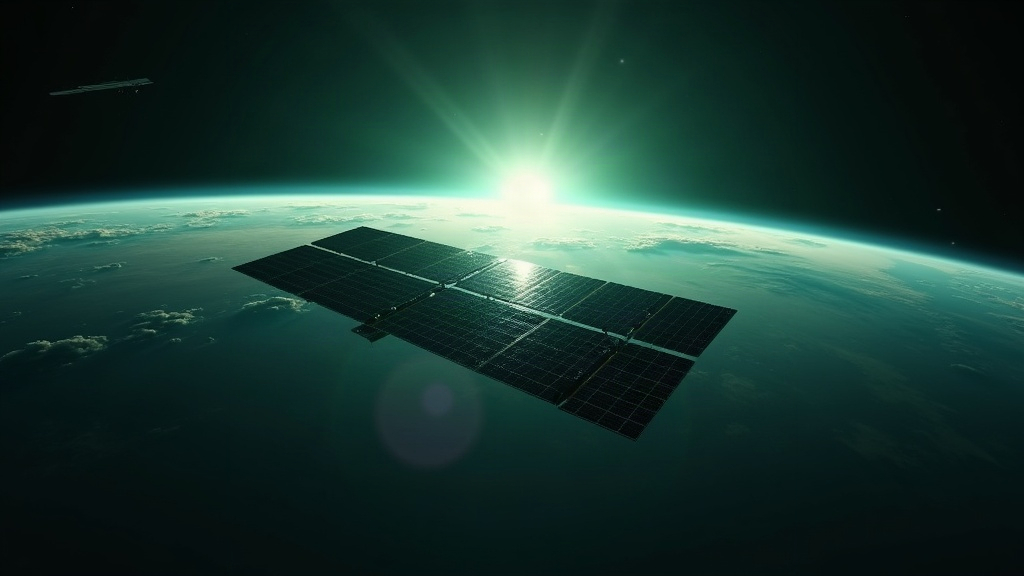
In short
US company Starcloud has raised 250 million dollars to place data centres in orbit around the Earth.
At a glance
- Funding: 250 million dollars (Series A extension), 2.3 billion dollar post-money valuation
- Investors: Manhattan West (lead), Nvidia with 25 million dollars, Cisco Investments, Benchmark, EQT
- Total capital since founding in 2024: 450 million dollars
- Background: first data centre graphics processor, an H100, flown to orbit in November 2025 aboard Starcloud-1, where a model was trained
- Use of funds: manufacturing capacity, joint engineering with Nvidia, securing future launch allocation
US company Starcloud has raised 250 million dollars to place data centres in orbit around the Earth. The round is a Series A extension and values the company at 2.3 billion dollars post-money. It was led by Manhattan West, with participation from Nvidia at 25 million dollars, Cisco Investments, Benchmark and EQT. That brings Starcloud's total capital raised since its founding in 2024 to 450 million dollars.
The collaboration with Nvidia is not new. In November 2025 Starcloud flew the first data centre graphics processor, an H100, into orbit aboard the Starcloud-1 satellite and, by its own account, trained a model on it there. The company says it is so far the only one operating such a processor outside the Earth's atmosphere.
The underlying idea targets the energy problem. Data centres on Earth compete for grid connections, land, cooling water and local permits. In orbit, unfiltered sunlight is permanently available, and in vacuum the water consumption of cooling disappears. The argument is therefore not "faster" but "supplyable at all".
Against that stand considerable technical hurdles. In vacuum, heat can only be radiated away, not carried off — which demands large radiator surfaces. Radiation damages electronics. Repairs are effectively impossible; failed hardware stays failed. And the data link back to Earth is limited, which favours workloads that compute a great deal and transmit little.
The current bottleneck lies elsewhere. According to TechCrunch, available launch opportunities are drying up — which is why the funds are explicitly also intended to secure future launch allocation, alongside expanding manufacturing capacity and joint engineering work with Nvidia. Anyone wanting to put data centres in orbit needs rockets first.
The venture is best read as a bet rather than an operating model. So far a single processor exists in orbit, not a data centre. The round funds the attempt to turn a demonstrator into a series — at a moment when the cost of data centres on the ground is rising noticeably.
FAQ
Why would a data centre in space be cheaper?
It is not the operation that is cheaper but the supply that is simpler. In orbit there is permanent solar power without a grid connection, land purchase or permitting process, and cooling needs no water. Getting there, by contrast, remains expensive.
How is waste heat disposed of?
In vacuum there is no air and no water to carry heat away. It can only be radiated, which requires large radiator surfaces. Cooling is therefore one of the central unsolved design problems for such systems.
Is a data centre already running up there?
No. What is documented is a single graphics processor in orbit since November 2025, on which the company says a model was trained. That is still a long way from a data centre in any meaningful sense.
Sources
- SpaceNews: Nvidia joins Starcloud's $250 million orbital data center funding round
- TechCrunch: Starcloud raises $250 million for orbital data centers as launch options dry up
- GeekWire: Starcloud raises $250M to support the creation of data center satellite network in league with Nvidia
- Business Wire: Starcloud Raises $250 Million at $2.3 Billion Valuation to Scale AI with Orbital Data Centers