AMD World Labs Acquisition: $8.2 Billion in Stock
The chipmaker pays in stock and makes Fei-Fei Li its chief scientist, seven months after joining a funding round that valued the startup at $5 billion.

In short
AMD is buying World Labs, the spatial-intelligence lab Fei-Fei Li founded in 2024, for about $8.2 billion in stock, and Li will become AMD's executive vice president and chief scientist.
At a glance
- Price: about $8.2 billion, paid in AMD stock.
- Founded in 2024, World Labs raised $1 billion at a $5 billion valuation in February 2026, with AMD among the backers.
- Models: Marble was the first product; Atlas builds 3D replicas of factories or warehouses from a few photos.
- Fei-Fei Li becomes executive vice president and chief scientist at AMD.
- The deal is expected to close before the end of 2026, subject to regulatory approval.
AMD is paying about $8.2 billion in its own stock for World Labs. Fei-Fei Li, who founded the lab in 2024 and built the ImageNet dataset, joins AMD as executive vice president and chief scientist. The deal is expected to close before the end of 2026, pending regulatory approval.
AMD was already an investor
In February 2026, World Labs raised $1 billion at a $5 billion valuation. AMD put money into that round, and so did Nvidia and Autodesk. Seven months later AMD is buying the company outright at roughly 64 percent above that mark.
Marble, Atlas, and what a world model actually does
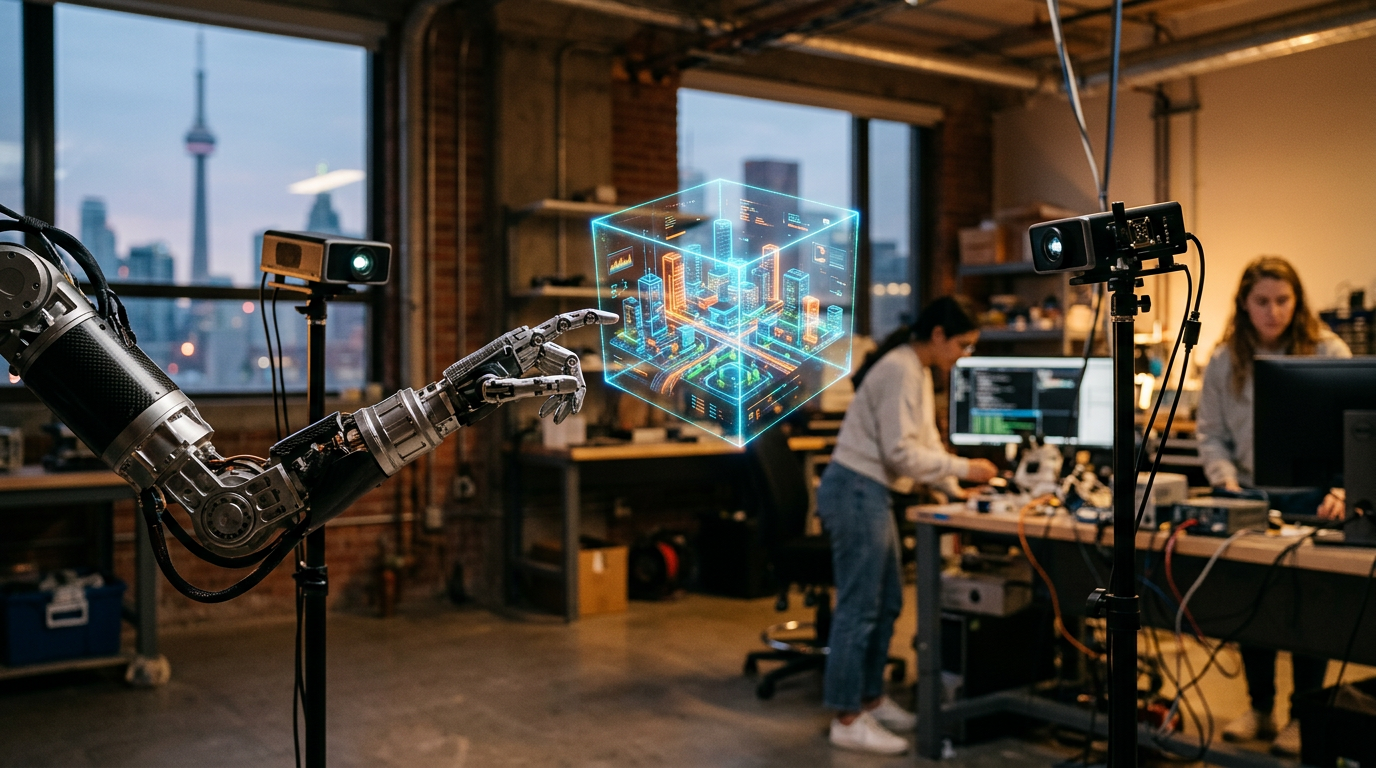
World Labs builds models that generate and sustain three-dimensional environments instead of text. Marble, its first product, was pitched both at entertainment work and at producing simulated spaces for robot training. Atlas, the newer model, is described as reconstructing a factory or warehouse from a handful of photos, simulating moving parts such as conveyor belts and attaching depth data so objects can be placed in space.
The label is loose. It stretches from language models trained to read visual input all the way to systems that render and hold a high-fidelity simulation of physical reality.
The hardware argument
CEO Lisa Su framed the purchase around chip design: building compute platforms for the next generation of AI, she said, requires a deep understanding of how models are evolving. Li said scaling the lab's work meant widening its reach and getting closer to the hardware. Both sides described AI development as work that demands close collaboration across model research, systems, and compute.
AMD recently introduced the Ryzen AI Embedded X100, a part aimed at robotics. Its largest deal before this one was Xilinx in 2022, at $50 billion.
Where this leaves AMD against Nvidia
Nvidia already ships open-weight world models, Cosmos among them. AMD has publicly offered only text and video models. The acquisition closes that gap on paper; whether it moves accelerator sales is a question the announcement does not address.
What could not be confirmed
The reports reviewed here give no headcount for World Labs, name no co-founders besides Li, and say nothing about how AMD shares traded on the news. A third outlet planned for this story could not be retrieved, so every figure above traces to the two sources linked below.
FAQ
How much is AMD paying for World Labs?
About $8.2 billion, paid in AMD stock. As recently as February 2026 the startup was valued at $5 billion.
What will Fei-Fei Li do at AMD?
She becomes executive vice president and chief scientist, and World Labs is to continue its AI research.
What is a world model?
An AI system that generates and simulates three-dimensional environments. The term is loose, covering everything from models that read visual input to full simulations of physical reality.