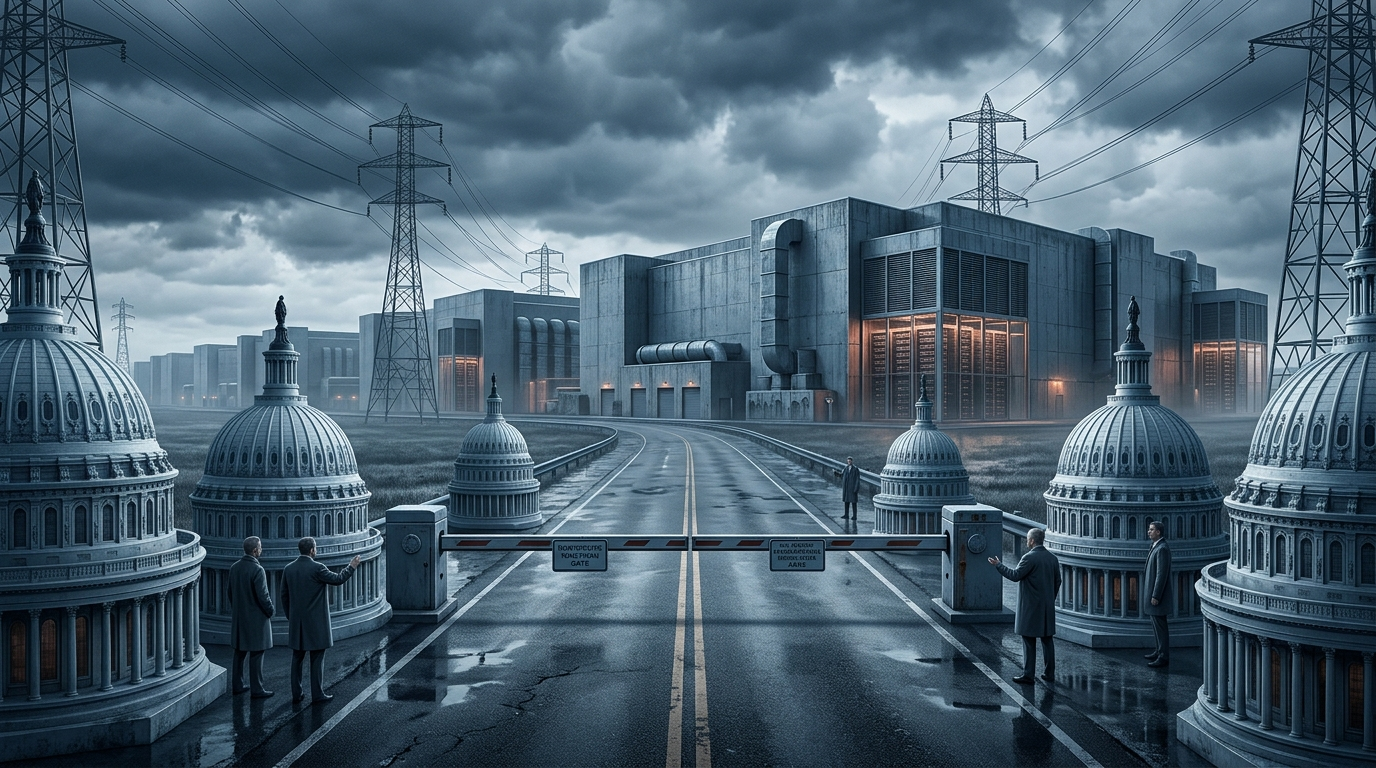
Newsom Order: California to Study an AI Kill Switch
The order mandates nothing yet: state officials have until November 16, 2026 to report whether halting an advanced AI model is even feasible.

In short
Newsom did not order a kill switch into existence; he ordered California officials to study whether one could work, with their report due November 16, 2026.
At a glance
- Signed September 18, 2026 — an executive order that imposes no immediate duty on AI companies.
- Report deadline: November 16, 2026, roughly two months after signing.
- Also under review: independent auditors stationed inside labs, and mandatory reporting of loss-of-control incidents.
- Newsom's premise: no federal law requires AI companies to report dangerous incidents.
- California enacted an AI safety law in 2025; in 2024 the governor vetoed a separate safety bill.
California Governor Gavin Newsom signed an executive order on September 18, 2026 that stops short of requiring a kill switch and instead asks whether one is buildable. State officials have until November 16, 2026 — roughly two months — to report back. Nothing in the order binds an AI company today.
What the order actually asks
A kill switch, as the order frames it, is the ability to halt an AI system once it is judged to have malfunctioned or gone off the rails. Officials must also weigh two adjacent ideas: obliging AI companies to host independent auditors inside their own labs, and requiring them to disclose loss-of-control incidents. All three arrive as questions for study rather than as rules, and the order does not commit the state to acting on whatever comes back.
The gap Newsom is pointing at
His argument is aimed at Washington, not Sacramento. No federal law requires AI companies to report dangerous incidents, and Newsom called the federal government's abject failure to create meaningful oversight something that should alarm every American — particularly, he said, when AI CEOs are themselves asking to be regulated. The Decoder reports he paired that with a call for Congress to treat California's existing rules as a national floor.
Industry and politics pull the same way
The signing doubles as a rebuttal to President Donald Trump, who has dismissed AI safety concerns as a hoax. Newsom is widely discussed as a 2028 Democratic presidential contender, which gives a state-level order a national audience. Sam Altman, Elon Musk and Demis Hassabis have all backed regulatory measures, and Anthropic's Dario Amodei has argued the industry must slow the pace at which it improves model capabilities.
Not California's first attempt
The state enacted an AI safety law aimed at large technology companies in 2025. In 2024 lawmakers passed an AI safety bill while the governor vetoed a separate one. California already has statutes covering child protection, deepfakes, data privacy and cybersecurity.
What the sources do not settle
Neither report names the experts involved, their budget, or whether the November 16, 2026 findings will be published. Neither defines the capability threshold at which a model counts as advanced — the line that would decide who any future requirement covers. Until that report lands, the kill switch is a research question with a deadline attached.
FAQ
Does California now require an AI kill switch?
No. The September 18, 2026 order commissions a feasibility review; it places no obligation on AI companies at this stage.
When is the California AI kill switch report due?
November 16, 2026, about two months after Newsom signed the executive order.
What else does Newsom's executive order examine?
Whether AI companies should host independent auditors in their labs and be required to report loss-of-control incidents.