Google's VERID lets AI agents run wet-lab robots
Three Google Research systems pair a semantic digital twin with closed-loop learning, lifting aptamer hit rates from 10.2 to 33.5 percent in three rounds.
In short
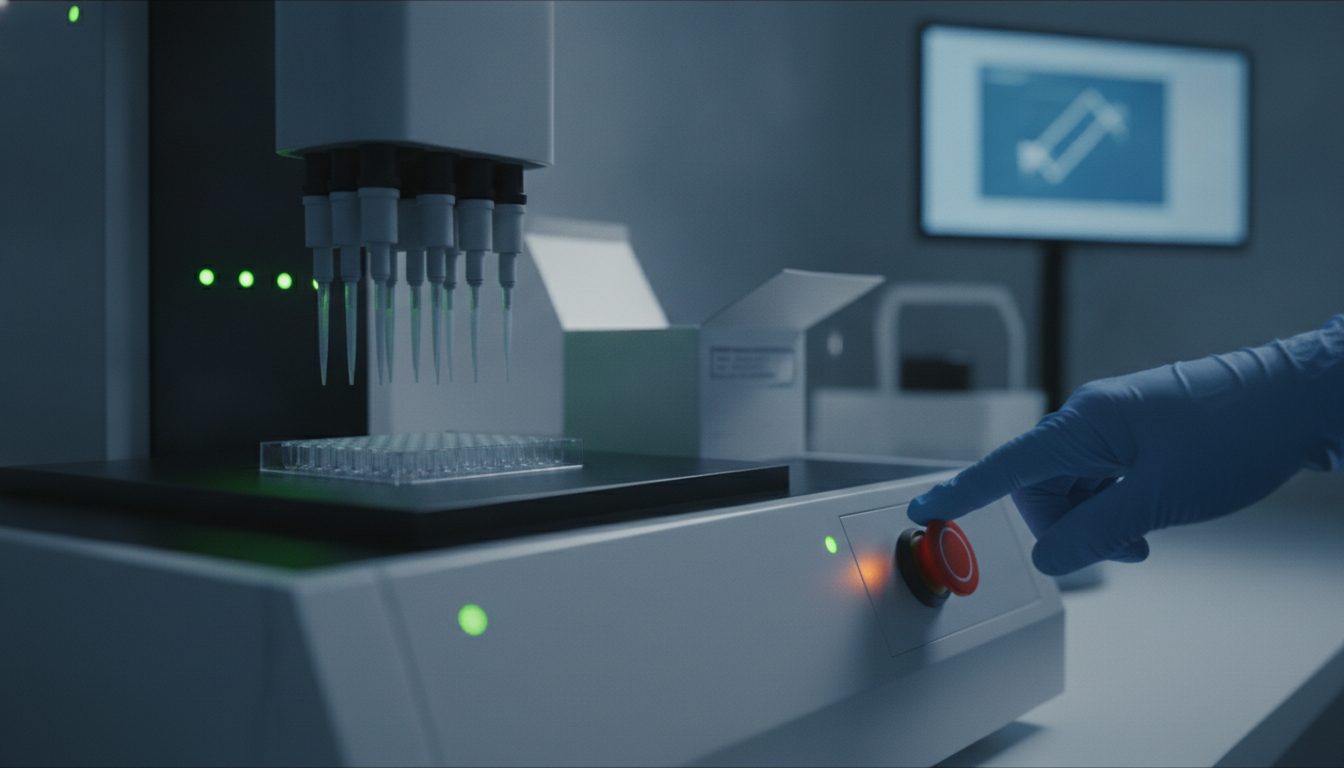
Google Research has published three building blocks for autonomous wet labs: VERID, a semantic digital twin of the lab workcell that gates every robot command, plus closed-loop agent pipelines for DNA aptamers and for de novo protein binders.
At a glance
- VERID is a semantic digital twin of the lab workcell, built on the open-source PyLabRobot framework.
- Myoglobin aptamers: 10.2% hit rate in round 1, 3.7% in round 2, 33.5% in round 3 at 72.4% specificity.
- Alpha-thrombin: zero binders in round 1, 26.0% in round 2, 42.1% hit rate at 98.5% specificity in round 3.
- Epitope excision accelerated each design cycle more than eightfold in silico; FAP binders hit single-digit nanomolar affinity.
- One aptamer cycle takes 7 to 10 days. Google names no specific model as the agent.
Google Research has laid out three systems meant to tie AI agents to what is physically true inside a laboratory: VERID, a digital twin of the lab workcell; a closed-loop pipeline for designing DNA aptamers; and an epitope excision workflow for protein binders. The October 16, 2026 post is credited to Pooja Rao, Petar Sirkovic and Annalisa Pawlosky. All three attack one bottleneck — models now propose experiments faster than hands and robots can run them.
A digital twin standing between the agent and the hardware
VERID is short for VERified Infrastructure for Discovery Laboratories. At its center sits a semantic digital twin: a live, stateful 3D tree that tracks robotic arm geometry, the volume in each individual well, reagent identities and pipette tip inventory. Google lists four capabilities — live 3D state tracking, virtual dry runs that finish in seconds, hardware safety checks that refuse invalid commands, and synchronized video and action logs. It runs on the open-source PyLabRobot framework.
The reason for that scaffolding is unflattering to the models themselves: frontier systems, Google writes, do not reason reliably about three-dimensional geometry or physical state. So no unverified code reaches the robots. Simulation is mandatory, and humans authorize sequences, protocols and runs.
Aptamers as the test bed
The team picked DNA aptamers binding myoglobin and alpha-thrombin as a tractable sandbox. Across three design-test-iterate cycles, myoglobin hit rates climbed from 10.2% to 33.5%, ending at 72.4% specificity. Alpha-thrombin produced no binders at all in round 1, reached 26.0% in round 2, then 42.1% at 98.5% specificity in round 3. Each round consumes 7 to 10 days of wet-lab time.
The dip in the middle is the story
Round 2 of the myoglobin campaign collapsed to a 3.7% hit rate and 19.1% specificity. The agents had over-optimized for G-quadruplex structures, and 63% of that round's designs turned out to be sticky, non-specific binders. Reading their own assay data, the agents capped the promiscuous motifs, subtracted bead binders and pivoted to non-G4 scaffolds — a ninefold recovery in on-target hit rates.
The alpha-thrombin shutout traced to fixed primer overhangs that disrupted folding in 48% of sequences. The agents added clamped flanking stems in later rounds. In both cases the correction is presented as self-diagnosed from experimental results rather than handed down by a human.
Binders against FAP
The third block targets fibroblast activation protein alpha, or FAP, a protein of interest in tumor research. Rather than predicting whole structures, the workflow excises the relevant epitope, which accelerated each cycle more than eightfold computationally. Human-agent collaboration nearly doubled in-silico hit rates against humans working alone. Candidates were validated with yeast surface display and fluorescence-activated cell sorting, yielding binders at single-digit nanomolar affinity.
Guardrails, and what Google says is unsolved
Experiments are confined to well-controlled, non-infectious biological systems with no gain-of-function risk, every designed sequence passes biosecurity screening, and the work is framed against Google's Frontier Safety Framework. The open problems are stated plainly: making sure agents optimize for genuine target binding instead of assay shortcuts, verifying multi-step wet-lab protocols, and continuously monitoring agent reasoning and execution traces.
Two things this article will not assert, because the post does not support them. No agent model is identified — there is no Gemini attribution in the text. And no cost figures are given for any campaign. Three accompanying papers are referenced; this write-up rests on the blog post alone, not on those papers.
FAQ
What is Google VERID?
VERID is a framework built around a semantic digital twin of a lab workcell. It tracks 3D state live, simulates protocols before execution, blocks invalid hardware commands and keeps synchronized video and action logs. It is built on the open-source PyLabRobot framework.
How well did Google's AI agents design aptamers?
Over three rounds, myoglobin hit rates rose from 10.2% to 33.5% at 72.4% specificity, and alpha-thrombin went from 0% to 26.0% and then 42.1% at 98.5% specificity. One round takes 7 to 10 days.
Do these wet labs run without human supervision?
No. Every run must be simulated first, and humans authorize the sequences, protocols and robot runs. Google calls these building blocks toward autonomous wet labs rather than finished autonomous labs.