MetaCaster: agents that build small forecasters
A nine-author preprint describes agents that turn a handful of examples into compact forecasting models, tested across 18 datasets and 23 forecasters.

In short
MetaCaster puts a team of agents to work generating training data, so a small forecasting model can be fitted from only a few real examples.
At a glance
- Preprint arXiv:2608.23473v1, submitted August 24, 2026, filed under cs.LG and cs.AI.
- Nine authors, including ChengAo Shen, Wenchao Yu, Dongjin Song and Jingchao Ni.
- Scale claimed in the abstract: 18 datasets, 23 lightweight forecasters, 14 baselines.
- Role reversal: the agents never forecast; they assemble the model that does the forecasting.
- Not peer reviewed: this is a preprint, and none of its claims are independently checked.
A preprint filed as arXiv:2608.23473v1 on August 24, 2026 sets out a system called MetaCaster, and its premise inverts the usual arrangement. The agents produce no forecast of their own. They produce the model that will do the forecasting, working from a small set of example data plus a plain-language description of the task.
The case for small models
Foundation models for time series are, in the authors' words, uneconomical once resources are tight. A compact forecaster tuned to one job is the cheaper option in that setting. The catch is that compact forecasters usually need a lot of training data to reach useful accuracy.
That requirement rules them out in exactly the places where they would help most: domains where measurements accumulate slowly, or where privacy rules keep the historical series off-limits. The paper frames this as a dilemma and takes few-shot learning for lightweight forecasters as its problem statement.
How the system is described
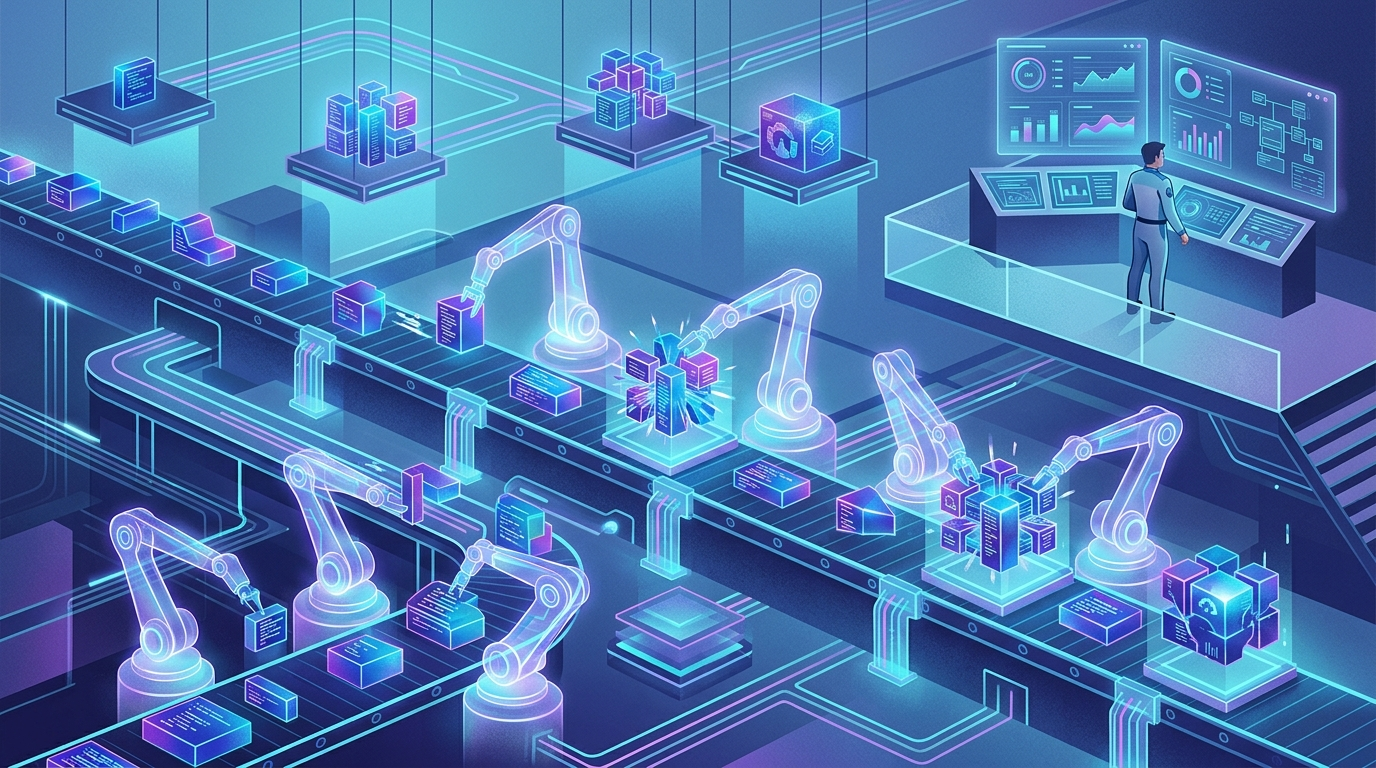
The authors call MetaCaster a meta-harness-optimized multi-agent framework. Its central mechanism is agentic data generation: agents manufacture the training material that the specialized forecaster is then trained on, automatically. The paper describes the agents as intermediary engineers preparing a task-specific model for deployment.
That shifts where the compute is spent. The expensive agent work happens once, at setup; afterward only the small model runs in production.
What was tested
The abstract gives three figures for the scope of the evaluation:
- 18 datasets
- 23 state-of-the-art lightweight forecasters
- 14 baselines
The authors claim the framework delivers both data efficiency and computational efficiency without giving up forecasting quality.
What is not established
This report rests entirely on the paper's public abstract page, and that page carries no numerical results at all. There is no error metric, no count of how few examples "few-shot" means in practice, and no runtime or cost figure. The efficiency claims are stated, not quantified.
The status of the work matters too: an arXiv preprint has passed no peer review. The abstract does not say which models drive the agents, what the generated training data looks like, or whether synthetic data genuinely eases the privacy constraint the authors invoke. Only one independent publication was available for this story, so nothing here has been corroborated by a second newsroom.
FAQ
What does MetaCaster do?
It is a multi-agent framework, described in a preprint dated August 24, 2026, that trains a compact time series forecaster from a few examples and a text description of the task.
Is MetaCaster a replacement for time series foundation models?
The authors do not claim that. They argue foundation models are uneconomical when resources are constrained, and propose automating the path to a small specialized forecaster instead.
Has the paper been peer reviewed, and are the results public?
No. It is a preprint without peer review, and the abstract reports only the scale of the study — 18 datasets, 23 forecasters, 14 baselines — with no accuracy or cost measurements.