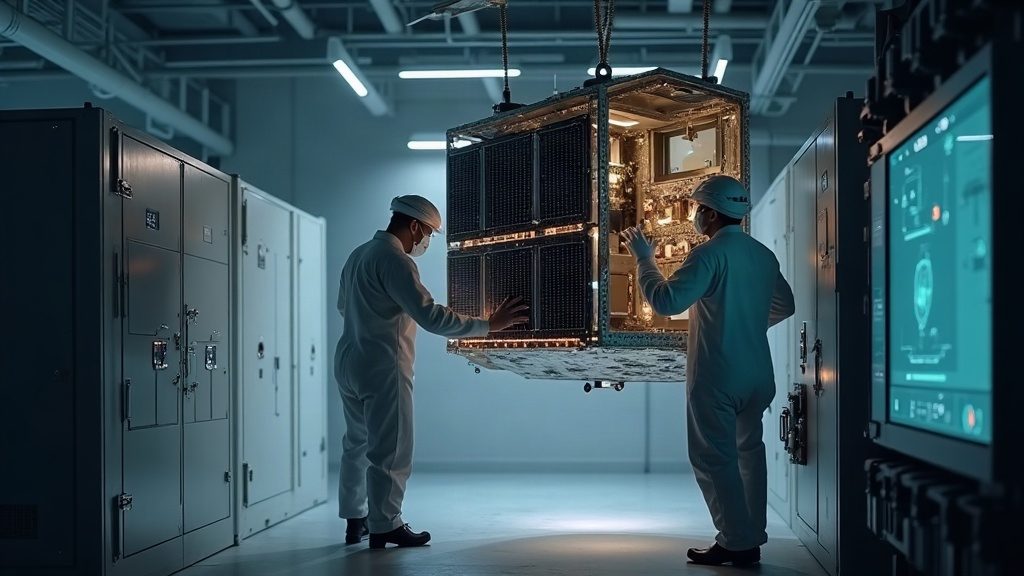
Google Suncatcher Satellite Launch Set for October 1
A Falcon 9 is set to carry Google's first Suncatcher satellite on October 1 — four Trillium TPUs, roughly one kilowatt of solar power, 15-minute compute bursts.
In short
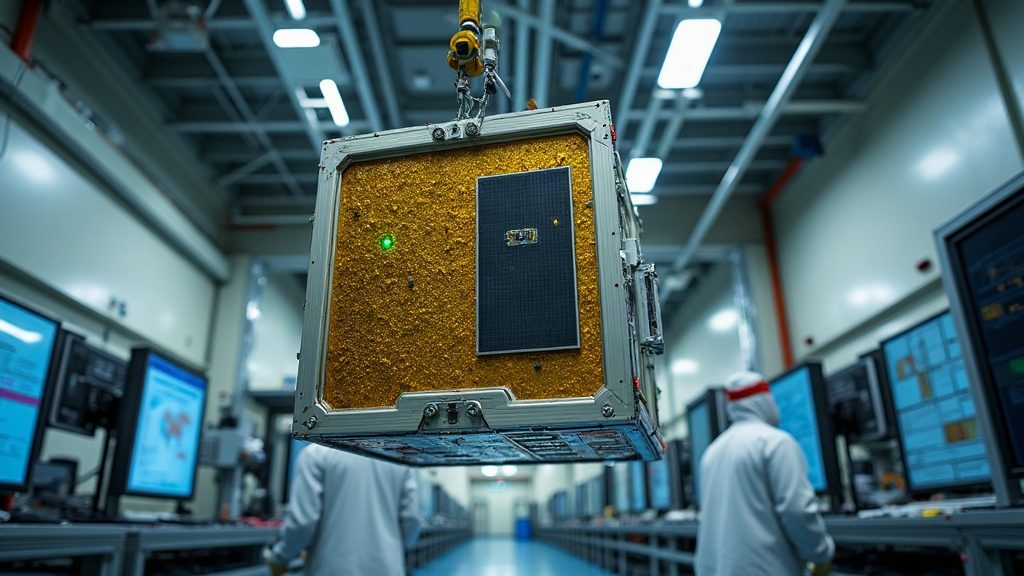
Google is putting a refrigerator-sized prototype satellite carrying four Trillium TPUs on a SpaceX Falcon 9 on October 1, 2026, to measure for the first time how its own AI accelerators behave in orbit.
At a glance
- Launch: October 1, 2026, on a SpaceX Falcon 9.
- Payload: four Trillium TPUs inside a roughly refrigerator-sized satellite called MVP, built by Planet Labs PBC.
- Power: solar panels supply only about one kilowatt, so the TPUs compute in bursts of roughly 15 minutes, then shut down to cool.
- Roadmap: two more satellites in 2027, those carrying high-performance lasers for data links.
- Project Suncatcher was announced in November 2025 and aims to move AI data centers into Earth orbit.
Google is sending a refrigerator-sized prototype satellite with four Trillium TPUs to orbit on a Falcon 9 on October 1, 2026. It is the first hardware test of Project Suncatcher, the company's bet that AI data centers can eventually run in space.
What is actually on the rocket
The spacecraft is named MVP, short for minimum viable product, and was built by satellite maker Planet Labs PBC. Inside are four Trillium TPUs, the same family of accelerators Google runs in its ground data centers. The mission is not a benchmark run: it measures whether the parts survive radiation, shed heat, and come through launch vibration intact.
Travis Beals, who leads the effort at Google, frames the flight as reconnaissance rather than a milestone — find out what holds up, find the failure points, feed both into the next missions. For a first flight, that is the accurate description.
One kilowatt is the real constraint
The number that shapes this mission is electrical, not computational. MVP's solar panels deliver only about one kilowatt, less than a single well-populated server rack draws on the ground. So the TPUs do not run continuously. They work in bursts of roughly 15 minutes and are then powered down to cool off.
There is no air in vacuum to carry heat away, so waste heat has to be radiated. Whether that scales is the open question standing between this prototype and anything resembling an orbital data center.
Lasers come next, in 2027
Two further satellites are planned for 2027, carrying high-performance lasers to test data links. That is the second bottleneck after cooling: a compute cluster in orbit has to move data between satellites and back down to Earth, fast.
Google is not alone in trying. SpaceX is pursuing orbital compute as well, alongside startups Starcloud and Orbital. Google first announced Project Suncatcher in November 2025.
What is not on the record
There are no published figures for orbital altitude, mission cost, or the size of any eventual constellation. Nor is there evidence yet on how well the cooling design performs — that is precisely what the flight is meant to establish. A launch is a test, not a proof that compute belongs in orbit.
FAQ
When does Google's Suncatcher satellite launch?
The launch is scheduled for October 1, 2026, on a SpaceX Falcon 9.
Which chips are on the Project Suncatcher satellite?
Four Trillium TPUs, Google's own AI accelerators, inside a roughly refrigerator-sized satellite built by Planet Labs PBC.
Can the satellite train AI models in space?
No. With about one kilowatt of solar power the TPUs only run in bursts of roughly 15 minutes; this flight tests radiation, cooling, and launch stress.